

 Apple Podcasts

 YouTube

 Spotify

 iHeartRadio

 Podchaser

 RSS Feed

 Amazon Music

 Podcast Addict

 PocketCasts

 Deezer

 PlayerFM

 Castro

 Castbox

 Goodpods
Private vs. Public Investor Relations: Building Trust with Institutional Investors — Deborah Smith
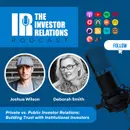
Deborah Smith, CEO of The CenterCap Group, on private vs. public investor relations and why trust and storytelling beat a strong track record with institutional investors.
Key Takeaways
- A strong track record is now simply table stakes in private and public real estate markets; to truly stand out, fund managers must know who they are independent of historical returns.
- Institutional investors like pension funds and endowments use pitch decks and marketing materials as a primary screening tool, making professional presentation quality critical.
- With the rise of generic AI-generated decks, authentic storytelling and human-to-human relationships provide a massive competitive edge that cold outreach cannot replicate.
- A warm introduction can easily save a year of cold calling, highlighting the importance of long-term network building and active participation in conferences and industry groups.
- Deepfake technology and advanced AI video generation mean traditional digital media can no longer be trusted blindly, creating a powerful resurgence in the value of face-to-face meetings.
Lots of managers have great track records. After years of low rates, Deborah Smith says that is table stakes, not a differentiator. To win institutional attention, you have to know who you are without it.
Deborah Smith, Co-Founder and CEO of The CenterCap Group and an independent director on the board of Aimco (NYSE: AIV), joins host Joshua Wilson to compare investor relations for private and public real estate companies. Drawing on 25+ years in real estate capital markets and seats on public, private, and industry boards, she explains how disclosure and reporting differ between private markets and regulated public markets, how institutional investors screen managers by their materials, and why storytelling, transparent communication, and warm introductions build trust faster than any cold outreach or AI-generated deck.
What We Cover:
- Investor relations for private vs. public real estate companies
- Disclosure, reporting cadence, and board elections in public markets
- Why CenterCap focuses on institutional capital
- How LPs use your deck and materials as a screening tool
- Storytelling beyond the track record
- Why a warm introduction can save a year of cold outreach
- "AI slop" and the case for differentiated materials
- A live deepfake demo, and what it means for trust online
- Conferences, events, and building a long-term network
- Why you should always respond to people who reach out
Connect with Deborah Smith
Website: centercapgroup.com
LinkedIn: linkedin.com/in/deborahsmith-centercap
Connect with Joshua Wilson
LinkedIn: https://www.linkedin.com/in/joshuabrucewilson/
About the show
The Investor Relations Podcast is produced by One Iron Network. Learn more at oneironnetwork.com.
Follow The Investor Relations Podcast
Website: theinvestorrelationspodcast.com
LinkedIn: linkedin.com/company/the-investor-relations-podcast
YouTube: youtube.com/@TheInvestorRelationsPodcast
A One Iron Network production: Executive Producer Joshua Wilson
Disclaimer: Joshua Wilson is a licensed Florida real estate broker and holds FINRA Series 79 and Series 63 licensure. The content of this podcast is for informational and educational purposes only and should not be considered legal, financial, or compliance advice. All views and opinions expressed by the host and guests are their own and do not necessarily reflect the policies or positions of any regulatory agency, organization, or employer. Listeners should consult their own legal counsel, compliance teams, or financial advisors to ensure adherence to applicable regulations, including SEC, FINRA, and other industry-specific requirements. This podcast does not constitute a solicitation or recommendation for any financial products or services.
Let’s Connect on LinkedIn:
https://www.linkedin.com/in/joshuabrucewilson/
To Contact Us, Please Visit:
https://www.theinvestorrelationspodcast.com/contact/
Frequently Asked Questions
What are the main differences between private and public real estate investor relations?
Private markets offer more latitude in disclosure content and direct connectivity with known investors, whereas public markets are strictly regulated regarding reporting cadence, standardized disclosures, and annual board elections.
How do institutional investors screen real estate fund managers?
Institutional investors evaluate the design, quality, and professionalism of incoming pitch decks and marketing materials as a primary screening tool before ever agreeing to a meeting.
Why are warm introductions important in institutional capital raising?
Warm introductions cut through the noise of hundreds of daily emails and AI-generated pitches, accelerating the transfer of trust and potentially saving years of fruitless cold outreach.
How is AI impacting investor relations materials?
While AI allows materials to be produced much faster, non-prolific users often create homogeneous 'AI slop,' driving the industry back toward differentiated, highly personal messaging and genuine relationship-building.
00:00 - Welcome and Deborah's Return to the Show
00:48 - Deborah's Background and The CenterCap Group
02:07 - Private vs. Public Investor Relations
03:56 - Institutional Capital: Who CenterCap Works With
05:58 - First Impressions: Materials as a Screening Tool
08:18 - Opening the Conversation: Storytelling Beyond Track Record
10:17 - Relationships vs. Technology in Investor Outreach
11:33 - AI Slop and the Case for Differentiated Decks
13:12 - Building Trust Through Events and Conferences
15:24 - Deepfakes and What Investors Can Trust Online
18:59 - Inbox Zero and the Power of a Network
22:28 - Always Respond: Deborah's Final Advice
Joshua Wilson:
Hey, good day, everybody. Welcome back to The Investor Relations Podcast. We're super grateful for you listening in. And we've been getting a lot of questions about the the idea of investor relations for you know for private deals versus the public market. So wanted to have one of my friends who I interviewed about four years ago on the Deal Scout. So if you look back through the archives of the Deal Scout and it's we've had a few transitions since then, you might hear the interview and and she has a great accent. So I think you guys will enjoy listening in. Deb, welcome back to the platform.
Deborah Smith:
Thank you. Thank you so much for having me back on. I don't know if I've got much of an accent anymore, but I'm glad I'm happy to take it. I'm happy.
Joshua Wilson:
Very cool. So let's let's start with this, Deb. Just for the people who haven't yet met your acquaintance, you know, tell us a little bit about who you are and what you do.
Deborah Smith:
Sure. I'm Australian. That's the partial accent. I I grew up in rural Australia back in the, you know, going into the nineties before I moved here to join. I started out with Morgan Stanley, did the bulge brackets, ran CBRE Global Investors for a couple of years, and then started up CenterCap Group, which is a boutique investment bank focused entirely on the real estate space. It's unusual in its services and that it does M&A primarily it's real estate owner operators developers as well as investment managers. It does capital raising, large separate accounts, programs as well as funds. And then we also have a consulting practice that does crisis management, corporate redesign, architecturing, governance work, succession planning, valuation opinions, and the like. The one key thing over there is that it doesn't involve a transaction. That's why it's on the consulting side. So, but we only work in real estate with a little bit of coverage on infrastructure. And I think, you know, for our conversation, what's helpful for listeners is that I sit on a public company board, I sit on a private company board, I'm I sit on boards of industry organizations. And so get to see a lot of different ways that people look at the roles of people in leadership positions and what their expectations are.
Joshua Wilson:
Yeah, that's fantastic. So, you know, private versus public, you know, when it comes, we're not talking even deals here. When it comes to working with investors and the communications and the strategies, you know, what are some of the the differences in in investor communications, investor relations for private deals versus public deals in the real estate space?
Deborah Smith:
Yeah. I I you know, I think let's just take one bucket a time. So on the on the private side, you know, you have tend to have a lot more clarity into who your investors are. You know who they are. You've probably sourced the commitment directly from them, you've definitely spoken to them. And so there is that connectivity there. But I also think what you distributed to them, you have a little more latitude as to what those things look like. And also it depends on whether it's corporate level or whether it is versus asset level. Right. And there's certainly no requirements around what you present when you present. There may be some requirements around content, but some of you have a lot more flexibility vis-a-vis what is going on in the public markets. Whereas on the public side, because they're regulated, then you are you you are subject to the reporting guidelines, you're subject to when you have to report your financials, you're subject to disclosure requirements. And so the and then of course your directors are up for the you held your annual elections once a year. So that that happens as well where the shareholders get to participate in who the board and the governance is of the company. So it's it's very different. And and similarly in the public markets, you you the the d there is a disconnect between the level of knowledge and interactions, I think. versus the private markets with your investors, as well as what the content and what those disclosures are.
Joshua Wilson:
Okay. So, you know, on on private deals, let's let's just talk about, you know, in the private deals, are you are you guys doing, you know, working the family offices or country club money or, you know, a credit investor? Like what what kind of what kind what sizes of deals do you guys typically work on and like what investor bases do you do typically work with?
Deborah Smith:
Yeah, that's a great question. So we only deal in the institutional market. That's it. So we're not working with really high net worth investors at all. The checks and size deals that we work on tend to be quite large. And so even if we're looking at fundraising, you're looking at an institutional universe of investors. They're usually pensions, endowment foundations, insurance companies, you know, sovereign wealth, folks like that. And even if we're working with parties on individual capital raises, it's similarly the same kinds of universe. The the reality is is the smaller checks, the family in even smaller family offices, if they reach the size of institutional, we we may deal with those like a cascade. But when they're smaller, those individual high net worths is not something that we spend any time on.
Joshua Wilson:
Okay. So, you know, are you when when looking at like maybe a family office, you know, for them, are you looking at them once they become like a quib or like they've they've reached that level of institution or is there is there a certain level where you're like, okay, you know, it it makes sense to work with this group rather than probably not a fit. Is there like a tipping point?
Deborah Smith:
Yeah, it's usually based on size of check. But I I think the other thing that portrays probably bigger into that is just who we know, right? And so unless it's a a name that can write a big check, it's it's not likely that we'll know them. And so if they're just high net worth families, unless there's some connection there that's been made to us, it's not going to be a universe that we're either pursuing, or quite frankly, that we have the expertise in order to explore it.
Joshua Wilson:
Yeah, fantastic. All right. So let's talk about for a moment. You know, we've done work with institutionalinvestor.com and we've run you know, part of their their conferences. When it comes to investor relations for institutional investors, it's a lot different than trying to get someone on a crowdfunding deal that's, you know, like correct. So talk to us about what are some of the things you've learned in investor relations for institutional investors.
Deborah Smith:
Yeah. So I think in institutional land, it's and it's interesting is that if you talk to limited partners and if you talk to even fund managers, it's the first point of contact, even how you present yourself and how you present your materials actually creates a really strong first impression. You know, someone said to me last week who was on the other side, a capital provider. said for a fund for owners and operators that are looking to explore institutional capital, it would behoove them to go and get professional expertise on putting together your materials. Because you may think they're great, but in institutional land where they see so many decks and so many sets of materials, then you can tell the difference between something that is very well put together and not and people use it as a screening tool. And so even at that basic level on first interaction, it's how you present. It's I'm sure I'm not sure it's any different than if you're going to go to a meeting to raise capital, whether you should show up in non-professional attire. See, I I think that, you know, those things create impressions. And so you have to be very deliberate about the impression you're trying to create and then how you're going to create it, right? So that's just on the first step getting in the door. I think once you have the capital. It's the same thing. It's the it's being the materials you sent out, your communications, I think should be transparent, they should be regular, and they should be straightforward and they should be honest. It's and I think that if investors, particularly institutional investors, are are very smart. And so I think d understanding that and appreciation appreciating the level of intellect will serve you well. in how you present and what you present to them.
Joshua Wilson:
Talk to us about, let's just say we're going, we're working on a mandate together. Okay. Your group, our group, and we're we're gonna go talk to some, you know, some groups out there. What's the process of you know, communications with them to to gain that level that first level of interest or conversation starter? Are you going to an analyst? Are you going to a CIO, a manager? Like, where do you start that conversation? Yeah.
Deborah Smith:
I know for us, is I've been doing this a long time. So I tend to only go to people at the top, as a as a rule of thumb, and and then figure out the best way forward for that. And it's using my relationship to do that. I I would say in that first communication, and it's probably a big reason we get hired now, is that getting that story right and that messaging right. And here's what I'll put in is that for example. An LP these days, they could get, you know, 200 emails a day, right? And they're seeing so many decks a week that the question you gotta ask was how do I get them to open my email? How do I get them to pay attention and want to follow up after my deck? And and so what we tell folks is on your communication with LPs, you have to be a storyteller. You have to decide who you are. independent of track record. And this will probably be news to a lot of folks, but lots of people have great track records. You know, interest rates were so low for so long. It's almost odd if you didn't have a great track record. But that will that just stops that may get you in the door, but it is not going to get you where you think you are, where you think you should, because so many people have it. So you have to figure out who you are and what you're selling. without relying on that track record. And if it holds, then you become a little more interesting.
Joshua Wilson:
Yeah. No, that's super good. Now, are you seeing a lot of you so you get that first conversation started and you know this is a I think that this is such a fundamental question, but I think it's so powerful for people to like latch on to that. Cause I think with AI and with technology out there, people could buy a list, they could look at a conference and and have AI scan the list, get their email addresses, and they could send out a hundred emails. In the matter of minutes now, which used to take you and me a
Deborah Smith:
Yeah. I know. I know.
Joshua Wilson:
So now when it comes to when it comes to the affinity or the types of deals that they're working on versus the technology, what AI can do versus relationships. Now you brought this up, you're like it's usually a relationship. Talk to us about relationships versus technology and AI leverage.
Deborah Smith:
Yeah. So I think at least for now, until everybody develops their own bots and everybody has a bot that can talk to everybody else's bot, in the absence of that happening for now and you actually have to use real people for that, I think it is still that that soft introduction will save you a year on a cold call reach out. I think that I think that's absolutely true. But here's another thing I I think is increasingly becoming interesting is for the past two years since AI has come in and people are getting up to up the speed. The non-prolific users who are moving to AI tend to produce what I call AI slop. It's it's like this AI presentation, they think it's really awesome. And I look at it and I s and I can tell it wasn't written by a human. And that's just the the difference between knowledge and access and how many decks that I see, so I can tell. So I think the next interesting evolution's going to be is who actually can make a deck that looks differentiated if everybody is using the same AI analysts to create their decks. We we will end up going back to where we were five years ago of you needing to write your own materials and you need to it needs to be you and who you are and what you put together. Because if you don't, then your deck is going to look like everybody else's. And so that skill used to be the one that prevailed. I think we'll get back to that. I think the difference will be is that we can just do that function so much faster than we used to be able to.
Joshua Wilson:
Yeah. There's an old saying, people do business with people they know, like, and trust. Out of that conversation, trust, I think, with AI out there, trust of what is real and what's not. I think, especially in family office and institutional investors, they're going, What could we even trust nowadays? And a relationship is transfer of trust. So that warm introduction is so valuable. It could cut off years of the, you know, that. So So for groups out there who are studying investor relations, that how can they, if they don't have a relationship to that to that group that they're looking to build, how do they build that through their investor relations strategy? What's something that they could wrap in to help that transfer of trust and begin to maybe get referrals or introductions? Like what have you found?
Deborah Smith:
I think there's a there's a couple of different ways to do it. I think if you have investors already, or if you have a vehicle holding those regular meetings, if you can do them in person, even better. Sponsoring networking events or getting or small gather ups is a nice place to plot, nice place to start. Or getting involved, showing up to conferences, showing up to events, and so people can see who you are. And connect. And and for the folks that are not used to doing that, it's really hard when you start attending conferences and you don't know a lot of people. So you have to be one of those people that is prepared to engage, doesn't mind meeting people that you don't know. And so if you can, if you're comfortable in that environment, it is a great way to build relationships, but you have to keep in mind all of these things take a really long time. And a lot of commitment. Yeah. A lot of commitment and a really long time. So you you have to you have to be in it and be prepared to put in the work or not in order to pull it off.
Joshua Wilson:
Yeah. I I think it's brilliant. I think and you do this a lot. You you're always traveling, you're always going to conferences, you speak, you're involved in in YPO, you're involved in private boards, public boards. Yeah. You write. Like you are on the I think it's that face to face, belly to belly, because then you could see the person and that trust is can be accelerated. Whereas I think people will see online, they're like, I don't even know if it's real. I think we're gonna see a a resurgence of face to face meetings, conferences and that that kind of stuff. Do do you think I'm heading in the right direction? Or do you think that, you know, COVID and everything killed that face to face and those conferences, or or do you think we're gonna see a resurgence?
Deborah Smith:
So this week I'm actually presenting at one of the pension plans for one out in California. Cool. And I will be giving them a demonstration of a video, giving them some exposure to how AI works and the extent of its capabilities. And one of the pieces of the demonstration is to where I can sho I'm showing them a video of me speaking. in circumstances that you would never see me speaking, delivering a very nice well-written speech. And but here's the interesting thing. I didn't present the speech. I have never been there, and I used a still photo of my head in order to create it in less than five minutes. And it has hand gestures, my face moving, everything. And and I the whole thing is entirely fake. The entire thing is fake. So I and and that You know, there used to be other technologies out there too where you could create, you know, ten second, fifteen second videos of you doing things. Similarly just off a still photo, a bio headshot. And I remember last year, as a joke, I sent out a Thanksgiving message of me chasing like a turkey through a yard. And of course I never caught the turkey. And and I sent it out to a whole bunch of people. They're like, my gosh, Deb, I can't believe you did that. I said, It's not real. But it sounded like me, looked like me, spoke like me, accent and all. And it's really quite incredible because on the one hand, it means you really shouldn't trust anything you see online anymore. You really shouldn't. Because I you know, chances are we can create it. You and I could sit here and have fun for 30 minutes and create all kinds of stuff. But the positive of it is it means that just think of the what you can do now I've told you that. You could do property tours. investor presentations. You can do traveling around and exploring things and never having gone to those places in order to record it. So if you were wanted to show your investors a property and you've never been there or it's or you want the ins and outs and or you have been there and you just don't the time, you can create a video that does that. As if you're there, but you're not. So it's it's so you can see a world where our written work becomes more video content similar to TikTok and everything else. So it becomes more video content so that people don't even have to open or read as much as they used to. I mean the possibilities now I've told you that are endless into what you can do. If you let your imagination grow, you can start recording video messages with people instead of sending them an email. Yeah. Right? And I'm telling you, this stuff it looks, sounds just like you. I can I can assure you we can make that stuff.
Joshua Wilson:
Yeah. Well, for me, man, I'm I'm teaching my kids right now. I have a thirteen year old, a nine year old, and a six year old. And I'm teaching them the the communication of being able to walk to someone, talk with them, shake their hand, look them in the eyes. Because I believe that we will all ask this question to ourselves within the next years, what's real? What could I even trust? And I think that what you're doing with conferences and with the YPO and with the groups that you're working with, I think it's really brilliant. And, you know, I think when When the world became digitized, I think everybody's like, cool, I can scale and they built this. And now it's getting like, is that even trustworthy anymore? And that I think that's the what you guys have cracked and what made you guys very valuable and successful in the in the meantime.
Deborah Smith:
Thank you. And and I look, I I I have realized over time that with the 'cause I know how many emails I get a day. And I know how much inbounds that I receive across our board. And so how do you and I just happen to be probably one of those people, fun fact, that I have no one read messages, no one read texts, no one read anything anywhere in my system, no one listened to voicemails. that I actually not the voicemails. It's funny enough, I don't always listen to my voicemails, but I'm really good on email and keeping it at zero. And and I do think that your point on people get buried very quickly. And so when they scroll through and they see names they know, they're more likely to open it. And I see this every day, even in our business, where someone could send out an email to someone I know and they don't get a response. And I can email them and we get a response two minutes later. And and with a how I didn't even know, I didn't even see anything. So I I think there is absolute merit to that. And and I would encourage anyone who knows that they ultimately want to raise capital or exit their business and you know one day you're gonna want to do that. I would start now on building and getting to know who is out there, right? And who is out there and building your own network. Because I find for our entire business, everything is an inbound, someone connected to somebody who's somebody to somebody. And so everything comes into us and we don't do as much outbound on looking for business development. But that is all created through a network that we've put a lot of time and effort into making sure there's got thousands of people in it, right? So that we can always tap that network and it keeps us in the flow of information and what's going on.
Joshua Wilson:
Yeah, super good. Well, Deb, I I love this conversation. I love what you're doing. For people who are listening in, you know, name some of the places where people could go to follow your work, to learn more with you and maybe even do a deal.
Deborah Smith:
Sure. So I'm on LinkedIn. Deborah Smith CenterCap. We CenterCap is on there as well. We have our website, centercapgroup.com. We've put out a lot of different research pieces. And I I I use that word a little lightly. I think what it is more, it's it's information of concepts and ideas which I think are coming down the pike in our industry from covering the ecosystem. So there's that, and you can pretty much put my name in and I pop up. So it's it's at this point, you know, in part some of the controversial views I have on different things. And there's a few aha moments where I I put out a piece and and then, you know, there'll be somebody who's like, I never thought about it that way. But I don't mind taking a differentiated opinion. I don't mind questioning the status quo. So when you do that, you end up a little bit more on Google than you are than you otherwise would.
Joshua Wilson:
Yeah, super cool. So people listening in the audience, you could always, you know, reach out to our guests. Our contact information will be in the show notes. I always encourage people to to reach out to our guests, say thanks for being on the show, but find ways to connect with them, find ways to add value to them or or you know, find ways to work together. So that'll be in there. Deb, are there any other questions that I probably should have asked you on topics of building trust institutional levels? That I might have missed, you know, private versus public. Is there is there maybe one other question that I should have asked you that I missed the mark?
Deborah Smith:
Yeah, and look, it's not so much that, but if I was to give a key piece of advice to everybody listening when it comes to investor relations or pretty much anything in life, and I tell my own family this, is never underestimate the value of what someone has based on what you think exists today. So meaning that if someone reaches out to you, I always respond. because I don't know who that person is, I don't know what their background is. But if I don't think it's an AI generated email, I'm like, that person took the time to reach out to me, and my time is no more or less important than theirs. So the least I can do is respond. And so when you take that, you would be amazed if you have that attitude and expect nothing out of it. Because there's no expectation in doing that, other than being a decent human being and responding. But you'd be amazed that the leads And and things that can come down. It might be today or tomorrow, but one day it comes back to you and you're like, my gosh. And so I really encourage that to never base what you think of of what people are in the relationships today, because you people change and the world changes and you will change and so will your expectations and you just never know where it can go.
Joshua Wilson:
Yeah, man, that's fantastic. Yeah. It's it's definitely a challenge over here. You're you're an inbox zeroer, just like I desire to be. So if people send me an email, you might get me or you might get someone on our team. I definitely try to do that. It is I feel like
Deborah Smith:
A lot.
Joshua Wilson:
It's a lie. I feel like it's one my AI team. Sometimes I've got teams of things doing stuff versus their AI team. And I feel like one day it's just gonna be like taking two phones and turning up and then AI talking to AI to figure out, you know, what makes sense. So
Deborah Smith:
It's very hard. And and I think as I've gotten older, I just have gotten super efficient. So I don't belabor a whole lot of stuff. I I look at it, move on, look at it, deal with it, decision tree and move on to the next thing. And if you I think in the the new world we're in, the the biggest the the the biggest challenge that we have is to deny procrastination and to deny kicking off to tomorrow. what can be done today because tomorrow has its own issues. So if you can get it done today, get it done today. And I think that is harder and harder too, because we're so overwhelmed with information and deliverables. And I think, you know, if you got out of bed each morning you looked at the list of all the crap you have to do that day, you would you wouldn't do it. So look at the first the few things in front of you and and get them done and move into the next thing. And then the world won't seem so hard and it won't seem so complicated.
Joshua Wilson:
Fantastic. All right, Deb. Well, thanks for coming back. And it's it's really good to reconnect with you and and hear all the progress you guys are making. Ladies and gentlemen, thanks for listening in. We'll see you all on the next episode. Cheers, guys.

Co-Founder & CEO, The CenterCap Group, board member of Aimco (NYSE: AIV) as well as a private infrastructure company
Deborah Smith is Co-Founder and Chief Executive Officer of The CenterCap Group, LLC, a Stamford, Connecticut-based investment bank and investment platform serving the institutional real estate investment management industry. She leads the firm's strategic direction and relationships across the institutional real estate ecosystem, advising REITs, investment managers, insurance companies, owner/operators, and developers on mergers and acquisitions, capital formation, and long-term growth strategies. Under her leadership, CenterCap has expanded beyond strategic advisory into sponsoring niche real estate investment strategies.
As both an active CEO and public company director, Ms. Smith brings a rare dual perspective on capital allocation, corporate governance, and long-term value creation. She is recognized for helping executive teams, boards, and institutional investors navigate periods of transformation while identifying opportunities to create durable competitive advantage.
A recognized leader in real estate capital markets, Ms. Smith has more than 25 years of experience advising public and private companies on complex strategic transactions. Throughout her career, she has advised on more than $100 billion in mergers and acquisitions, capital formation, and restructuring transactions.
Prior to co-founding CenterCap, Ms. Smith was Co-Head of M&A and Senior Managing Director at CB Richard Ellis Investors (now CBRE Investment Management), where she helped establish the firm's mergers and acquisitions platform and led the acquisition of a majority int… Read More